
NIST SP 800-37: A complete guide to the risk management framework
Organizations today face increasing cybersecurity risks, regulatory demands, and compliance challenges. To address these, the National Institute of Standards and Technology (NIST) developed a structured process known as the Risk Management Framework (RMF). The official guidance for RMF is documented in NIST SP 800-37, one of the most important NIST publications for information security.
This blog explains what NIST SP 800-37 is, why it matters, the steps of the Risk Management Framework, and how businesses can use CyberArrow GRC to automate and simplify compliance.
What is NIST SP 800-37?
NIST SP 800-37 is the official publication titled “Guide for applying the risk management framework to federal information systems.” It provides a standardized process for managing cybersecurity risk in government and business environments.
The RMF was designed to:
- Improve security decision-making.
- Help organizations meet compliance requirements.
- Align cybersecurity with organizational missions and business objectives.
The latest revision, NIST SP 800-37 Revision 2, was released in December 2018. It expands RMF to promote a more holistic approach by linking risk management with privacy and supply chain considerations.
Why NIST SP 800-37 matters
Cybersecurity incidents are costly. According to IBM’s 2023 Cost of a Data Breach Report, the global average cost of a breach reached $4.45 million. With threats increasing every year, organizations cannot afford weak or inconsistent risk management practices.
NIST SP 800-37 ensures organizations have:
- A repeatable, structured framework for risk management.
- Clear guidelines for security authorization of information systems.
- Integration of privacy, security, and compliance in one lifecycle.
It is not only used by U.S. federal agencies but also adopted globally by private organizations seeking a gold-standard risk management approach.
The NIST Risk Management Framework (RMF) steps
The heart of NIST SP 800-37 is the seven-step RMF process. Let’s break them down in simple terms.
1. Prepare
Organizations establish governance, assign roles, and identify system boundaries. Preparation ensures stakeholders understand responsibilities before security controls are selected.
2. Categorize
Systems are categorized based on the impact of potential breaches: low, moderate, or high. This step follows FIPS 199 standards and helps prioritize resources.
3. Select
Organizations choose appropriate security controls from NIST SP 800-53 based on system categorization. Controls cover areas like access control, incident response, and encryption.
4. Implement
Selected security controls are put into practice. This includes technical measures such as firewalls, policies like access management, and training employees.
5. Assess
Controls are tested to confirm effectiveness. Independent assessors often perform security control assessments to ensure there are no gaps.
6. Authorize
Based on assessment results, an authorizing official decides whether the system can operate. This is the “go or no-go” decision for system deployment.
7. Monitor
Continuous monitoring ensures ongoing compliance and security. Systems are reviewed, updated, and tested as threats evolve.
Key benefits of NIST SP 800-37
Adopting NIST SP 800-37 and the RMF offers several advantages:
- Improved risk visibility: Organizations can see risks clearly and prioritize high-impact areas.
- Regulatory compliance: Helps meet requirements for standards like FISMA, HIPAA, PCI DSS, and ISO 27001.
- Stronger security posture: Systems become more resilient against cyberattacks.
- Scalability: The framework works for both small businesses and large enterprises.
- Alignment with business goals: Cybersecurity becomes part of organizational strategy rather than just an IT function.
Quick link: NIST password guidelines
Challenges with manual RMF compliance
While NIST SP 800-37 provides a strong structure, implementing it manually is often a challenge. Many organizations struggle with:
- Documentation overload: Collecting and updating audit evidence is time-consuming.
- Human error: Manual risk assessments can miss critical details.
- Costly consultants: Hiring external experts for every phase adds significant cost.
- Slow audits: Compliance cycles take months instead of weeks.
A recent survey by Gartner found that 61% of organizations using manual compliance methods experience delays in risk assessments. This highlights the need for automation.
How CyberArrow GRC simplifies NIST SP 800-37 compliance
Instead of relying on manual processes, CyberArrow GRC automates much of the RMF compliance journey.
Here is how it helps at each stage:
- Preparation: Assigns roles, tracks responsibilities, and centralizes governance.
- Categorization: Maps systems and data automatically to risk levels.
- Selection: Provides pre-mapped control sets from NIST SP 800-53 and other frameworks.
- Implementation: Tracks control deployment and ensures proper documentation.
- Assessment: Automates evidence collection and streamlines third-party assessments.
- Authorization: Offers real-time dashboards to support informed authorization decisions.
- Monitoring: Enables continuous compliance with alerts, reporting, and dashboards.
With its zero-touch audit approach, CyberArrow GRC reduces compliance cycles by up to 70%, cuts consulting costs, and ensures organizations stay aligned with NIST standards without added stress.
Read also: NIST standards: A complete guide to understanding and achieving compliance
Real-world example
A financial services firm that adopted CyberArrow GRC for NIST compliance reported:
- 50% faster assessment cycles.
- 40% lower compliance costs.
- Improved collaboration across IT, compliance, and executive teams.
This demonstrates the practical value of automating NIST SP 800-37 compliance instead of relying only on traditional methods.
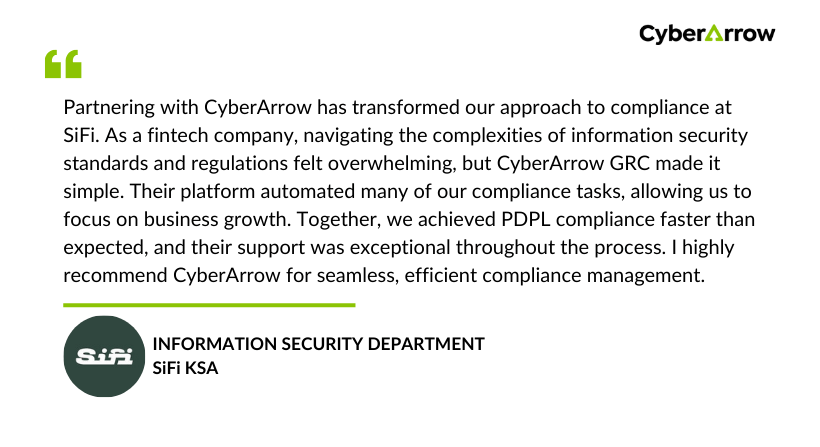
See what our clients have to say about CyberArrow GRC:
Conclusion
NIST SP 800-37 is the backbone of effective cybersecurity risk management. It gives organizations a structured, repeatable way to protect systems and ensure compliance.
However, manual compliance is inefficient, costly, and prone to error. By adopting CyberArrow GRC, organizations can automate NIST compliance, achieve faster audits, and maintain ongoing security alignment with minimal effort.
CyberArrow GRC makes NIST SP 800-37 compliance simpler, smarter, and faster helping businesses reduce risk while focusing on growth.