
Top 10 security awareness training metrics
Organizations invest heavily in cyber security tools, but one risk that continues to cause the majority of security incidents is human error.
Employees may unintentionally click phishing links, share confidential data, or ignore security policies. Because of this, organizations now invest in security awareness training programs that educate employees about cyber risks and safe behavior.
However, simply delivering training is not enough. Organizations must measure whether their awareness programs actually reduce risk.
Security teams must track measurable indicators that demonstrate whether awareness initiatives are effective, improving employee behavior, and supporting compliance requirements.
In this guide, we explain the top 10 security awareness training metrics that organizations should track to evaluate their programs and strengthen their security culture.
- Why security awareness training metrics matter
- Key characteristics of effective awareness metrics
- Top 10 Security Awareness Training Metrics
- 1. Training completion rate
- 2. Training assessment scores
- 3. Phishing Simulation Failure Rate
- 4. Phishing reporting rate
- 5. Repeat offender rate
- 6. Time to report security incidents
- 7. Policy acknowledgment rate
- 8. Awareness program participation rate
- 9. Security incident reduction trend
- 10. Risk score improvement
- How leadership uses security awareness metrics
- Common challenges when tracking awareness metrics
- The role of automation in security awareness training
- How CyberArrow Awareness Platform supports security awareness training metrics
- Why CyberArrow Awareness Platform is the best choice in 2026
- Final Thoughts
- FAQs
Why security awareness training metrics matter
Many organizations launch security awareness training programs but fail to measure outcomes properly.
Without metrics, it becomes difficult to answer key questions such as:
- Are employees learning from training programs?
- Is phishing risk decreasing?
- Are employees reporting incidents faster?
- Is security awareness improving across departments?
Metrics provide visibility. They help organizations evaluate program effectiveness, identify weaknesses, and demonstrate value to leadership.
Metrics also support regulatory expectations. Many frameworks require organizations to demonstrate that awareness programs are active and effective.
Examples include:
Security awareness training metrics provide the evidence required to show that employees understand and follow security practices.
Key characteristics of effective awareness metrics
Before reviewing specific metrics, organizations should ensure that their measurement approach follows several principles.
Metrics should be:
- Measurable: Data should be collected consistently and objectively.
- Actionable: Metrics should help organizations improve training programs.
- Relevant to risk: Metrics should relate directly to employee behavior and security outcomes.
- Consistent over time: Tracking trends helps demonstrate improvement.
Strong metrics turn awareness programs into measurable risk management initiatives.
Top 10 Security Awareness Training Metrics
Below are the most important metrics organizations should track.
1. Training completion rate
Training completion rate measures how many employees successfully complete required training modules.
This metric is calculated by dividing the number of employees who completed training by the total number required to participate.
A high completion rate indicates that employees are participating in awareness programs.
However, completion alone does not guarantee understanding. It should be combined with other metrics.
Tracking completion rates also supports compliance documentation during audits.
2. Training assessment scores
Assessment scores measure how well employees understand training content. After completing awareness modules, employees often take quizzes or knowledge tests.
Assessment scores help organizations determine whether employees understand topics such as:
- Phishing awareness.
- Password security.
- Data protection practices.
- Incident reporting procedures.
Low scores may indicate that training materials need improvement.
3. Phishing Simulation Failure Rate
Phishing simulation tests help organizations measure how employees respond to simulated phishing emails.
The phishing failure rate represents the percentage of employees who clicked on malicious links or submitted credentials during the simulation.
This is one of the most important security awareness training metrics because phishing attacks remain one of the most common causes of breaches.
A decreasing failure rate over time indicates improved employee awareness.
4. Phishing reporting rate
The phishing reporting rate measures how often employees correctly report suspicious emails.
This metric shows whether employees recognize threats and follow reporting procedures.
Organizations should encourage employees to report potential phishing attempts.
A higher reporting rate often indicates a stronger security culture.
5. Repeat offender rate
Some employees repeatedly fail phishing simulations or ignore training guidelines. Repeat offender rate tracks how often the same individuals continue to demonstrate risky behavior.
Identifying repeat offenders allows organizations to provide targeted training. Role-specific training can help reduce risk among high-exposure users.
6. Time to report security incidents
Another important metric is how quickly employees report security incidents. When employees notice suspicious activity, fast reporting can reduce the impact of an attack.
Measuring reporting speed helps organizations understand whether employees know how to escalate issues.
Faster reporting times typically indicate improved awareness and confidence in incident reporting processes.
7. Policy acknowledgment rate
Many organizations require employees to review and acknowledge security policies.
Policy acknowledgment rate measures how many employees confirm that they understand and accept policies, such as:
- Acceptable use policy.
- Password policy.
- Data handling guidelines.
- Remote work security policies.
This metric demonstrates that employees are aware of security expectations. It also provides important documentation during audits.
8. Awareness program participation rate
Participation rate tracks how many employees engage with awareness activities beyond mandatory training.
Examples include:
- Awareness campaigns.
- Security newsletters.
- Awareness events.
- Micro learning sessions.
High participation levels indicate strong engagement and cultural adoption.
9. Security incident reduction trend
Organizations should analyze whether the number of security incidents decreases as awareness training improves.
For example:
- Fewer phishing-related incidents.
- Fewer data handling mistakes.
- Reduced credential sharing.
- Fewer policy violations.
This metric connects training directly to risk reduction.
10. Risk score improvement
Some advanced awareness platforms calculate employee risk scores based on behavior.
Risk scores may consider factors such as:
- Training results.
- Phishing simulation performance.
- Reporting behavior.
- Security compliance patterns.
Improvement in risk scores over time demonstrates that training programs are working. Risk-based metrics help organizations prioritize training efforts.
Quick link: RTO vs RPO: Definition, differences and uses
How leadership uses security awareness metrics
Leadership teams increasingly expect measurable outcomes from cyber security initiatives.
Security awareness training metrics help leadership understand:
- Employee risk exposure.
- Training effectiveness.
- Compliance readiness.
- Security culture maturity.
These insights help organizations allocate resources more effectively and support strategic security planning.
Common challenges when tracking awareness metrics
Despite the importance of metrics, many organizations struggle with measurement.
Common challenges include:
- Manual tracking systems: Spreadsheets create inconsistencies and lack real-time visibility.
- Disconnected tools: Training systems may not integrate with risk management or compliance platforms.
- Limited reporting: Security teams may struggle to generate leadership-level reports.
- Incomplete data: Metrics may be scattered across multiple systems.
Automation can address these issues.
The role of automation in security awareness training
Automation simplifies awareness management.
Modern awareness platforms can:
- Deliver structured training programs.
- Run phishing simulations.
- Track employee participation.
- Measure behavior changes.
- Generate compliance reports.
- Maintain centralized documentation.
Automation also improves scalability across large organizations.
How CyberArrow Awareness Platform supports security awareness training metrics
CyberArrow Awareness Platform is designed to help organizations manage security awareness training programs in a structured and measurable way.
The platform helps organizations:
- Deliver cyber security training modules.
- Conduct phishing awareness simulations.
- Track employee participation and performance.
- Measure key security awareness training metrics.
- Maintain centralized documentation.
- Generate compliance-ready reports.
Because the CyberArrow Awareness Platform operates within the broader CyberArrow GRC ecosystem, awareness data can connect directly to governance and risk management processes.
This integration allows organizations to link awareness outcomes to:
- Risk registers.
- Compliance frameworks.
- Control monitoring.
- Audit evidence.
As a result, awareness becomes part of a structured enterprise security program rather than an isolated training activity.
Quick link: What is incident reporting?
Why CyberArrow Awareness Platform is the best choice in 2026
Organizations today require more than simple training tools.
They need solutions that support:
- Enterprise-scale training programs.
- Continuous awareness campaigns.
- Measurable security awareness training metrics.
- Compliance documentation.
- Integration with governance and risk management processes.
CyberArrow Awareness Platform provides these capabilities within a full enterprise GRC environment.
By automating awareness training delivery, participation tracking, phishing simulations, and reporting, CyberArrow helps organizations reduce human risk while maintaining audit readiness.
For organizations seeking to strengthen their security awareness training program and demonstrate measurable improvements in employee behavior, CyberArrow Awareness Platform provides a reliable and scalable solution.
Final Thoughts
Security awareness training is one of the most effective ways to reduce human risk in cyber security.
However, training alone is not enough. Organizations must measure effectiveness through structured metrics.
Tracking key indicators such as phishing failure rates, reporting behavior, training completion, and risk score improvements allows organizations to evaluate progress and strengthen their security culture.
A structured awareness platform simplifies this process. CyberArrow Awareness Platform provides organizations with the tools needed to automate security awareness training programs, measure key metrics, and integrate awareness into enterprise governance and compliance processes.
For organizations looking to build a mature and measurable security awareness strategy, CyberArrow Awareness Platform offers a powerful and scalable solution.
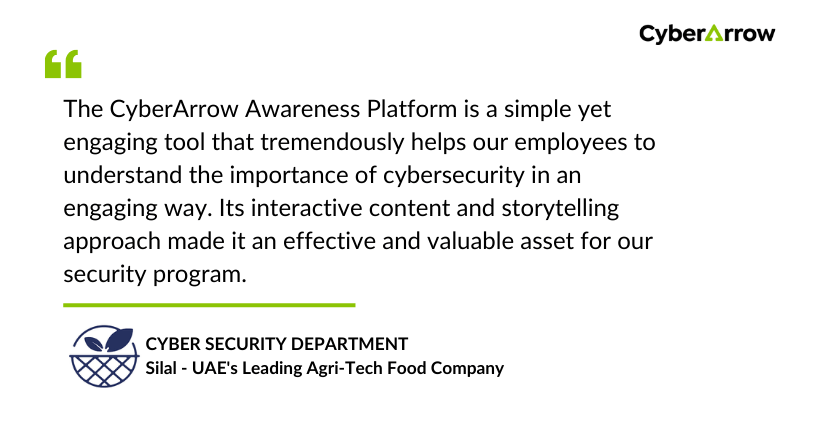
See what our clients have to say about CyberArrow Awareness Platform:
FAQs
What is security awareness training?
Security awareness training is a structured program designed to educate employees about cyber security risks, safe online behavior, and data protection responsibilities. It helps organizations reduce human error, prevent phishing attacks, and improve overall security posture.
Why are security awareness training metrics important?
Security awareness training metrics help organizations measure the effectiveness of their training programs. By tracking metrics such as phishing failure rates, reporting rates, and training completion, organizations can identify gaps and improve employee security behavior.
How can organizations track security awareness training metrics effectively?
Organizations can track security awareness training metrics using centralized awareness platforms that monitor participation, assessments, phishing simulations, and reporting behavior. Platforms like CyberArrow Awareness Platform help automate tracking and provide compliance-ready reporting.