COBIT framework: A complete guide to IT governance and management
Every organization runs on IT, but not every organization’s IT is actually driving business value. That gap between what technology does and what the business needs it to do is where governance failures live: missed compliance requirements, security blind spots, wasted budget, and IT decisions made in isolation from business strategy.
The COBIT framework exists to close that gap. Developed by ISACA, it’s one of the most widely adopted frameworks for IT governance and management, used by organizations to align technology decisions with business goals, manage IT-related risk, and meet regulatory and audit requirements.
If you’re new to COBIT or trying to understand how the 2019 update changed things, this guide covers what you need to know.
- What is COBIT?
- The COBIT 2019 framework structure
- Seven components of a COBIT governance system
- COBIT design factors
- What the COBIT framework helps organizations govern and manage
- How COBIT 2019 implementation works
- COBIT performance, capability, and maturity assessment
- Simplify compliance with the COBIT framework with CyberArrow
- FAQs
What is COBIT?
COBIT stands for Control Objectives for Information and Related Technologies. It is an enterprise governance and management framework developed by ISACA to help organizations govern and manage their information and technology.
The COBIT framework is broader than a set of IT controls. It provides a way to connect enterprise objectives with technology-related decisions, processes, responsibilities, resources, and performance. Organizations can use COBIT to establish governance practices, identify priorities, assess capabilities, and improve how I&T supports business goals.
One of the most important concepts in COBIT is the distinction between governance and management.
Governance
Governance is the responsibility of the governing body. It involves evaluating stakeholder needs, conditions, and options. It also helps set direction through prioritization and decision-making, and monitor performance and compliance against the agreed direction and objectives.
In practical terms, governance answers questions such as:
- What should the organization prioritize?
- What outcomes should I&T deliver?
- How much I&T-related risk is acceptable?
- Are technology investments producing the expected value?
Management
Management is responsible for planning, building, running, and monitoring activities in alignment with the direction established by the governing body. Management therefore focuses on putting those decisions into practice. This includes planning I&T activities, implementing solutions, operating services, managing risks and resources, and monitoring performance.
Effective IT governance is not simply about managing IT operations. Governance determines direction and oversight, while management executes that direction.
A brief history of the COBIT framework
The COBIT framework has evolved considerably since its first release in 1996. Each major version expanded the framework’s scope as organizations’ dependence on technology changed.
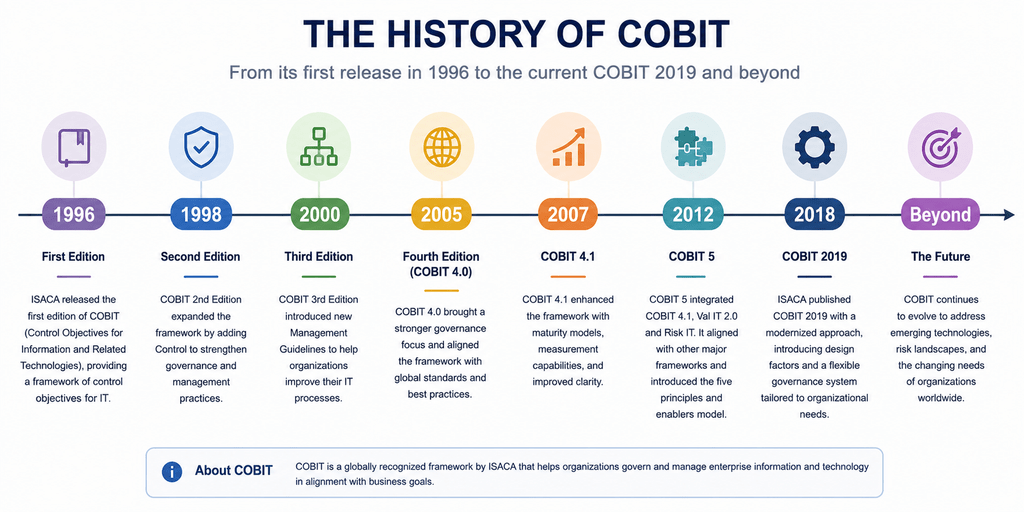
The move from COBIT 5 to COBIT 2019 is particularly important. COBIT 2019 replaced the earlier concept of enablers with governance system components, introduced design factors for tailoring governance systems, and updated the performance management approach.
Organizations using older COBIT material should therefore avoid assuming that COBIT 5 terminology maps directly to COBIT 2019.
The COBIT 2019 framework structure
COBIT 2019 provides a core model containing 40 governance and management objectives. These objectives are organized into five domains.
| Domain | Name | Focus |
| EDM | Evaluate, Direct and Monitor | Governance activities performed by the governing body. |
| APO | Align, Plan and Organize | Strategy, organization, planning, and supporting I&T activities. |
| BAI | Build, Acquire and Implement | Acquisition, development, implementation, and integration of I&T solutions. |
| DSS | Deliver, Service and Support | Delivery and support of I&T services, including security and operational activities. |
| MEA | Monitor, Evaluate and Assess | Performance, internal control, compliance, and assurance. |
The five domains do not all represent governance activities. EDM contains the governance objectives, while APO, BAI, DSS, and MEA contain management objectives.
For example, EDM includes objectives such as establishing governance frameworks, delivering benefits, optimizing risk and resource management, and engaging stakeholders. Management objectives in other domains include risk management, security, vendor management, operations management, business continuity management, and compliance with external requirements.
The 40 objectives provide the core reference model, but COBIT does not expect every organization to treat every objective as equally important. Organizations can prioritize objectives based on their own circumstances.
Seven components of a COBIT governance system
COBIT 2019 takes a broader view of governance than processes alone. A governance system includes seven components:
- Principles, policies and frameworks.
- Processes.
- Organizational structures.
- Information.
- People, skills and competencies.
- Culture, ethics and behavior.
- Services, infrastructure and applications.
These components work together to support governance and management objectives. For example, an organization cannot effectively manage information security simply by defining a security process. It also needs appropriate organizational responsibilities, skilled personnel, relevant information, supporting technology, policies, and a culture that supports secure behavior.
This is one of the major differences between a narrow control checklist and the COBIT approach.
COBIT design factors
COBIT 2019 is designed to be tailored rather than implemented identically across all organizations. Design factors help organizations determine what their governance system should look like based on their specific circumstances. These factors can include the organization’s strategy, goals, risk profile, threat landscape, compliance requirements, role of I&T, sourcing model, technology adoption strategy, and other characteristics.
For example, an organization operating in a highly regulated industry may prioritize governance and management objectives related to risk, compliance, security, and assurance. A technology company with a heavy reliance on cloud services may have different priorities.
The design process therefore starts with the COBIT core model and adjusts priorities according to the organization’s context rather than treating the framework as a fixed checklist.
What the COBIT framework helps organizations govern and manage
COBIT provides a common structure for connecting business priorities with I&T governance and management. Its value comes less from simply adopting a list of objectives and more from using those objectives to clarify what needs to be governed, who is responsible, and how performance should be evaluated.
Organizations can use COBIT to:
- Align I&T with enterprise goals: Connect technology priorities and investments with the outcomes the organization needs to achieve.
- Improve risk oversight: Establish a structured approach for identifying and governing I&T-related risks.
- Clarify accountability: Define responsibilities across governing bodies, management, organizational structures, and other stakeholders.
- Manage technology resources: Improve oversight of people, applications, infrastructure, information, and other I&T resources.
- Monitor performance: Establish ways to evaluate whether governance and management activities are achieving their intended objectives.
- Support assurance and compliance activities: Provide governance and management criteria that can be used alongside regulatory requirements and other frameworks.
COBIT is not itself a regulatory compliance standard. An organization does not generally become COBIT compliant in the same way it may demonstrate conformity with a standard such as ISO 27001. Instead, organizations can use COBIT to structure governance, control, risk, assurance, and improvement activities, while mapping or aligning these activities with applicable requirements.
How COBIT 2019 implementation works
Implementing COBIT is not simply a matter of adopting all 40 objectives at once. COBIT 2019 provides implementation guidance for establishing and improving an enterprise governance system.
The approach uses seven phases, providing a structured path from recognizing the need for change to maintaining improvements.
At a high level, the phases address:
- What are the drivers? Identify the reasons for change and the business context.
- Where are we now? Understand the current state of governance and management.
- Where do we want to be? Establish the desired future state and improvement priorities.
- What needs to be done? Develop and plan the improvement program.
- How do we get there? Execute the planned improvements.
- Did we get there? Review whether the changes produced the intended results.
- How do we keep the momentum going? Sustain and continuously improve the governance system.
The implementation process should be connected with the COBIT design workflow. Organizations first need to understand their context and determine which parts of the governance system are relevant before implementing improvements.
COBIT performance, capability, and maturity assessment
COBIT 2019 includes a COBIT Performance Management (CPM) approach for evaluating governance and management performance.
One distinction is especially important: capability levels and maturity levels are not the same thing.
A process can be assessed using capability levels from 0 to 5, which indicate how well the process is implemented and performing. These levels are applied to processes associated with governance and management objectives.
Maturity levels are used at the focus-area level. A focus area can cover a particular topic or area of interest and provide a higher-level view of performance.
This distinction is important because older COBIT resources may use maturity terminology differently. COBIT 2019’s performance management approach is based on concepts aligned with CMMI and provides capability levels for processes alongside maturity levels for focus areas.
An assessment can compare an organization’s current capability with its target capability and identify gaps that need to be addressed.
Simplify compliance with the COBIT framework with CyberArrow
Understanding the COBIT framework is one thing; implementing and maintaining it across a growing organization is another. CyberArrow GRC helps IT governance and compliance teams map COBIT objectives to real controls, track maturity over time, and stay audit-ready without relying on spreadsheets or manual tracking.
Whether you’re just starting your COBIT journey or looking to streamline an existing implementation, CyberArrow gives you the visibility and automation to make governance manageable. It also helps cross-map overlapping requirements with frameworks like ISO 27001, SOC 2, and NIST, so you’re not rebuilding your compliance program from scratch for every standard.
With continuous control monitoring and AI-powered dashboards, CyberArrow moves your organization from reactive, pre-audit scrambles to always-on audit readiness.
See how CyberArrow supports COBIT compliance.
FAQs
Is COBIT mandatory for compliance?
No. COBIT is a voluntary framework, not a legal or regulatory requirement. Organizations adopt it to strengthen IT governance and often to support compliance with other regulations or standards (like SOX, GDPR, or ISO 27001) that require demonstrable IT controls.
What’s the difference between COBIT and COBIT 2019?
COBIT 2019 is simply the most recent version of the framework, released by ISACA in 2018. It introduced design factors, an updated governance/management structure, and the Core Model of 40 objectives.
Do I need a certification to use COBIT?
No. Organizations can adopt COBIT without any staff holding formal certification. However, ISACA offers COBIT certifications (Foundation, Design & Implementation, and others) for professionals who want formal training, which can be valuable for auditors, risk managers, and IT governance leads.
How long does COBIT implementation typically take?
It varies significantly by organization size and scope. A focused implementation covering a few priority processes might take a few months, while a full enterprise-wide rollout across all 40 objectives can take a year or more. COBIT’s design-factor approach is meant to help organizations scope this realistically rather than attempting everything at once.