A complete guide to GRC risk management process
Organizations today operate in a complex environment. Cyber threats are increasing. Regulations are expanding. Customers expect stronger security and accountability. In this environment, managing risk is no longer optional. It is a core business function.
This is where GRC risk management becomes critical. GRC risk management combines governance, risk management, and compliance into one structured process. It helps organizations identify risks, assess impact, implement controls, and maintain ongoing oversight. Without a structured GRC risk management process, organizations face higher exposure, audit failures, and operational disruption.
This guide explains the full GRC risk management process step by step, common challenges, and how automation improves results.
- What is GRC risk management
- Why GRC risk management matters
- The complete GRC risk management process
- Common challenges in GRC risk management
- The role of automation in GRC risk management
- GRC risk management across multiple frameworks
- Why manual GRC risk management is unsustainable
- How CyberArrow GRC strengthens GRC risk management
- Why CyberArrow GRC is the best choice for automating GRC risk management
- FAQs
What is GRC risk management
GRC risk management is the structured process of identifying, assessing, managing, and monitoring risks within an organization while aligning with governance policies and compliance requirements.
It connects three key elements:
- Governance, which defines leadership oversight and policies.
- Risk management, which identifies and evaluates risks.
- Compliance, which ensures regulatory requirements are met.
Instead of managing these areas separately, GRC risk management integrates them into one coordinated program.
Why GRC risk management matters
Risk affects every organization. These risks may include:
- Cyber security threats.
- Data protection failures.
- Regulatory violations.
- Operational disruptions.
- Third-party vendor failures.
If risks are not managed in a structured way, small issues can become major incidents.
GRC risk management helps organizations:
- Reduce financial loss.
- Improve regulatory readiness.
- Strengthen internal controls.
- Increase leadership visibility.
- Protect reputation.
It creates clarity and accountability.
The complete GRC risk management process
A strong GRC risk management program follows a structured cycle. Each step builds on the previous one.
Step 1: Establish governance framework
The first step is defining governance. Leadership must define:
- Risk appetite.
- Policies and standards.
- Roles and responsibilities.
- Oversight structure.
Without clear governance, risk management lacks direction. Governance ensures that risk decisions align with business objectives.
Step 2: Identify risks
Risk identification involves recognizing potential threats and vulnerabilities.
Common sources of risk include:
- Technology systems.
- Human error.
- Regulatory changes.
- Supply chain partners.
- Physical infrastructure.
Risk identification should involve multiple departments, including IT, legal, compliance, operations, and finance.
A complete inventory of risks forms the foundation of GRC risk management.
Step 3: Assess and prioritize risks
After identifying risks, organizations must assess their impact and likelihood.
Risk assessment typically includes:
- Evaluating potential financial impact.
- Measuring operational disruption.
- Assessing legal consequences.
- Considering reputational damage.
Each risk receives a score based on severity and probability. Prioritization ensures that high-risk areas receive attention first.
Step 4: Implement risk controls
Controls are measures that reduce or manage risk.
Controls may include:
- Access management systems.
- Encryption and technical safeguards.
- Policies and procedures.
- Employee training.
- Vendor monitoring.
Each control should be documented and linked to specific risks. This step moves risk management from theory to action.
Step 5: Monitor and test controls
Risk management is not a one-time exercise. Controls must be monitored and tested regularly.
Monitoring includes:
- Reviewing system logs.
- Conducting internal audits.
- Validating compliance evidence.
- Tracking remediation actions.
Testing ensures controls work as intended. Without monitoring, controls can become outdated or ineffective.
Step 6: Report to leadership
Leadership needs clear visibility into risk posture. GRC risk management requires structured reporting that shows:
- High priority risks.
- Control effectiveness.
- Compliance gaps.
- Remediation progress.
Reports should be clear, accurate, and timely. Effective reporting supports informed decision-making.
Step 7: Continuous improvement
Risk environments change, new threats emerge, and regulations evolve.
GRC risk management must include continuous improvement by:
- Updating risk assessments.
- Revising policies.
- Enhancing controls.
- Learning from incidents.
This ensures long-term resilience.
Common challenges in GRC risk management
Many organizations struggle with GRC risk management due to:
- Manual spreadsheets.
- Disconnected systems.
- Lack of ownership.
- Inconsistent risk scoring.
- Limited visibility for executives.
Manual processes create delays and errors. As organizations grow, these challenges become more serious.
The role of automation in GRC risk management
Automation transforms GRC risk management from reactive to proactive.
Automation helps organizations:
- Centralize risks and controls.
- Standardize risk scoring.
- Collect evidence automatically.
- Monitor controls continuously.
- Generate real-time reports.
Automation reduces manual effort and improves accuracy. It also supports compliance across multiple frameworks at the same time.
GRC risk management across multiple frameworks
Organizations often follow more than one framework, such as ISO 27001, NIST, GDPR, or industry-specific standards.
Managing risks separately for each framework leads to duplication. An effective GRC risk management program maps risks and controls across frameworks, reducing redundant work and improving consistency.
Why manual GRC risk management is unsustainable
Manual approaches rely on:
- Email reminders.
- Spreadsheet updates.
- Shared documents.
- Periodic reviews.
These methods lack real-time visibility and create gaps between audits. As regulatory scrutiny increases, manual systems struggle to meet expectations.
How CyberArrow GRC strengthens GRC risk management
It supports:
- Centralized risk identification and tracking.
- Automated risk scoring.
- Control mapping across frameworks.
- Continuous evidence collection.
- Real-time dashboards and reporting.
- Remediation tracking.
CyberArrow reduces reliance on spreadsheets and fragmented tools. It provides structure and visibility across governance, risk, and compliance functions.
Why CyberArrow GRC is the best choice for automating GRC risk management
Effective GRC risk management requires automation, consistency, and leadership visibility.
CyberArrow GRC delivers:
- Automated workflows.
- Pre-mapped frameworks.
- Continuous compliance monitoring.
- Scalable architecture.
- Audit-ready documentation.
Instead of preparing for audits once a year, organizations remain continuously ready.
CyberArrow simplifies complex risk environments and reduces operational burden.
For organizations seeking to modernize their GRC risk management process and move beyond manual systems, CyberArrow GRC provides the most effective and scalable solution.
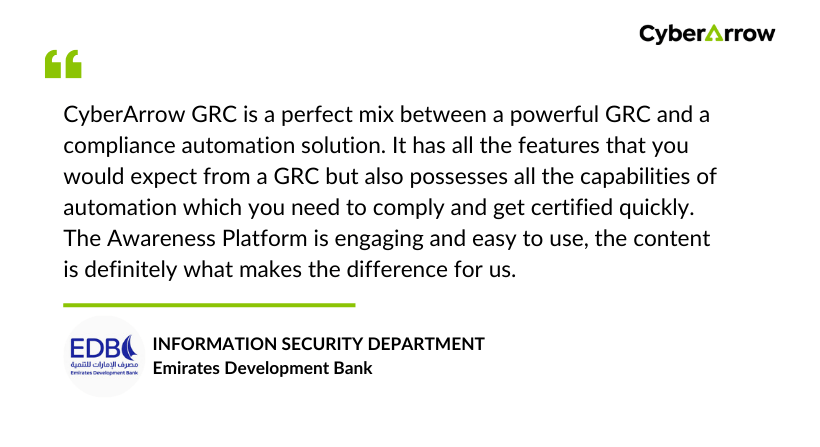
See what our clients have to say about CyberArrow GRC:
FAQs
What is GRC risk management?
GRC risk management is the structured process of identifying, assessing, controlling, and monitoring risks while aligning with governance policies and compliance requirements.
Why is GRC risk management important for organizations?
GRC risk management helps reduce financial loss, improve regulatory readiness, strengthen internal controls, and give leadership clear visibility into risk exposure.
What are the main steps in the GRC risk management process?
The main steps include establishing governance, identifying risks, assessing and prioritizing risks, implementing controls, monitoring controls, reporting to leadership, and continuous improvement.
How does automation improve GRC risk management?
Automation centralizes risks and controls, standardizes risk scoring, collects evidence automatically, and provides real-time reporting, reducing manual effort and errors.
How can CyberArrow GRC support GRC risk management?
CyberArrow GRC automates risk tracking, control mapping, evidence collection, and reporting, helping organizations maintain continuous compliance and audit readiness.