Best GRC software for financial services to achieve DORA
Financial institutions today face growing pressure to prove digital resilience. Banks, insurance firms, and fintech companies handle massive amounts of sensitive data, and any disruption can cause serious financial and reputational loss. The European Union has introduced the Digital Operational Resilience Act (DORA) to ensure every financial service provider can withstand and recover from cyber incidents.
Meeting DORA’s strict requirements can be complex, especially for organizations managing multiple systems, vendors, and risk frameworks. This is where modern GRC software becomes essential. It helps financial institutions manage governance, risk, and compliance in one place while automating much of the manual work needed for DORA readiness.
This guide explains what DORA means for financial services, how GRC software supports compliance, and compares the top tools that can help your organization achieve operational resilience with less effort and more accuracy.
- Understanding DORA in simple terms
- Why GRC software matters for DORA compliance
- Key features to look for in GRC software for financial services
- Comparative review of top GRC software for financial services
- Comparison summary
- How GRC software helps with DORA readiness
- Practical steps to implement GRC software for DORA
- Common challenges in DORA compliance
- Why CyberArrow GRC is the ideal partner for DORA compliance
- FAQs
Understanding DORA in simple terms
The Digital Operational Resilience Act (DORA) is an EU regulation that came into effect in 2023 and will be fully applicable from January 2025. Its goal is to strengthen the financial sector’s ability to manage and recover from digital disruptions such as cyberattacks, IT failures, or data breaches.
DORA applies to:
- Banks and credit institutions.
- Insurance and reinsurance firms.
- Investment firms and funds.
- Payment and electronic money institutions.
- Crypto asset service providers.
The regulation requires organizations to follow strict standards across five main areas:
- ICT risk management: Ensuring systems are secure and resilient.
- Incident reporting: Detecting, classifying, and reporting incidents quickly.
- Digital operational resilience testing: Regularly testing systems and processes.
- Third-party risk management: Monitoring all ICT vendors and service providers.
- Information sharing: Sharing threat intelligence across the financial ecosystem.
Each of these areas involves ongoing monitoring, documentation, and control verification. Doing this manually can quickly become overwhelming, especially for financial institutions with large data ecosystems.
Why GRC software matters for DORA compliance
GRC stands for Governance, Risk, and Compliance. A good GRC software platform helps financial institutions manage all compliance tasks in one place. Instead of tracking spreadsheets, teams can automate evidence collection, monitor risks in real time, and generate reports instantly.
Here is how GRC software supports DORA readiness:
- Centralized risk management: Financial institutions deal with multiple risks across operations, IT, and vendors. GRC software creates a single source of truth for identifying, assessing, and mitigating risks.
- Automated compliance tracking: The platform can map controls to DORA requirements and automatically check if systems meet compliance standards.
- Incident reporting and audit trails: GRC tools help log incidents, assign response tasks, and keep an audit-ready record for regulatory reviews.
- Third-party oversight: DORA demands strict oversight of vendors and ICT providers. GRC software tracks vendor performance, collects compliance certificates, and flags potential gaps.
- Testing and continuous monitoring: Platforms provide dashboards that track resilience tests, recovery metrics, and policy updates, ensuring continuous compliance.
By automating these steps, GRC software helps financial institutions stay compliant and resilient while saving time and reducing costs.
Key features to look for in GRC software for financial services
When choosing a GRC tool for DORA compliance, financial firms should look for the following features:
- Regulatory mapping: Built-in mapping of DORA, GDPR, ISO 27001, and NIS2 controls.
- Incident and risk tracking: Real-time dashboards for monitoring threats and incidents.
- Vendor risk management: Centralized system for assessing third-party risks and contracts.
- Automation: Ability to pull evidence automatically from cloud, security, and IT systems.
- Reporting: Ready-to-use reports for regulators and auditors.
- Scalability: Capability to grow with your organization as new regulations are added.
Comparative review of top GRC software for financial services
Below is a practical comparison of leading GRC software platforms that help financial institutions achieve DORA compliance.
1) CyberArrow GRC
Best for: Complete DORA compliance automation with a focus on ease of use and scalability.
Why financial institutions choose it: CyberArrow GRC helps automate up to 90 percent of the DORA compliance process. The platform offers built-in templates for risk assessments, incident reporting, and third-party management. Its intuitive interface provides a full overview of compliance status, control maturity, and audit readiness.
The platform integrates with major cloud providers and cyber security tools, allowing financial institutions to collect and verify evidence automatically. CyberArrow GRC also supports multiple frameworks such as ISO 27001, GDPR, and NIST, which simplifies compliance for multi-regulated entities.
Standout feature: Cross-mapping between DORA and other compliance frameworks to save time and avoid duplication of work.
2) ServiceNow GRC
Best for: Large financial institutions with complex IT infrastructure.
Why it stands out: ServiceNow GRC provides powerful automation workflows and deep integrations across IT systems. It is ideal for banks and large financial service providers with in-house IT and security teams.
Limitations: Setup requires time and technical support. Smaller institutions may find it complex and costly.
3) MetricStream GRC
Best for: Enterprises needing advanced reporting and analytics.
Why it stands out: MetricStream offers detailed dashboards, compliance libraries, and workflow customization. It is suitable for financial firms with dedicated compliance departments.
Limitations: May be too feature-heavy for smaller firms or fintech startups.
4) IBM OpenPages
Best for: Organizations seeking strong integration with existing IBM systems.
Why it stands out: IBM OpenPages provides data-driven insights and AI-powered risk prediction tools. It suits institutions that want to link operational risk with compliance management.
Limitations: Complex pricing and integration process compared to lighter GRC tools.
5) OneTrust GRC
Best for: Financial institutions focused on privacy and third-party management.
Why it stands out: OneTrust combines privacy management, third-party risk monitoring, and compliance automation in one platform. It helps institutions align DORA with other EU privacy rules like GDPR.
Limitations: May require additional modules for full DORA mapping and monitoring.
Comparison summary
| Feature | CyberArrow GRC | ServiceNow | MetricStream | IBM OpenPages | OneTrust |
| Ease of use | Excellent | Moderate | Moderate | Moderate | Good |
| Automation level | High | High | Medium | Medium | High |
| Vendor risk management | Yes | Yes | Yes | Yes | Yes |
| Cross-framework mapping | Yes | Limited | Yes | Yes | Partial |
| Setup time | Fast | Moderate | Moderate | Moderate | Moderate |
| Best fit | Mid-size to large financial institutions | Large enterprises | Established banks | IBM users | Privacy-focused firms |
How GRC software helps with DORA readiness
A strong GRC platform supports each pillar of DORA compliance:
- ICT risk management: Helps document controls and monitor system performance.
- Incident reporting: Logs all incidents and prepares regulator-ready reports.
- Resilience testing: Tracks testing schedules, results, and follow-up actions.
- Third-party risk: Manages vendor contracts and performance evaluations.
- Information sharing: Enables documentation and secure sharing of threat insights.
When these functions are automated, financial teams can stay compliant without getting buried in paperwork.
Practical steps to implement GRC software for DORA
- Assess current compliance maturity: Identify gaps in ICT risk and vendor management.
- Define scope: Choose which parts of your organization will fall under DORA monitoring first.
- Select a suitable GRC platform: Pick software that supports automation and multi-framework mapping.
- Migrate data and controls: Upload your current policies, incidents, and vendor lists.
- Train users: Educate compliance teams on workflows and reporting dashboards.
- Monitor and review: Use continuous monitoring features to track compliance progress.
By following these steps, financial institutions can build a more resilient and audit-ready environment.
Common challenges in DORA compliance
Even with technology support, some challenges remain common across the financial industry:
- Managing multiple regulatory frameworks simultaneously.
- Keeping vendor compliance data up to date.
- Ensuring employee awareness and training.
- Avoiding duplication of evidence and reports.
- Demonstrating real-time operational resilience.
The right GRC software can address all of these by connecting systems, automating evidence collection, and offering visibility across the organization.
Why CyberArrow GRC is the ideal partner for DORA compliance
For financial institutions preparing for DORA, choosing the right GRC software can define the difference between stress and success. Among the tools reviewed, CyberArrow GRC stands out for its automation, ease of use, and regulatory coverage.
CyberArrow GRC simplifies DORA readiness with pre-built templates, automated workflows, and clear dashboards that track every part of your compliance journey. It also supports frameworks like ISO 27001, GDPR, and NIS2, helping financial institutions maintain a unified compliance strategy.
By choosing CyberArrow GRC, your organization gains:
- End-to-end DORA compliance coverage.
- Automated risk and vendor management.
- Real-time monitoring and reporting.
- Easy scaling across multiple frameworks.
CyberArrow GRC is the complete solution for financial institutions aiming to meet DORA requirements efficiently while maintaining trust, transparency, and resilience in a rapidly changing digital landscape.
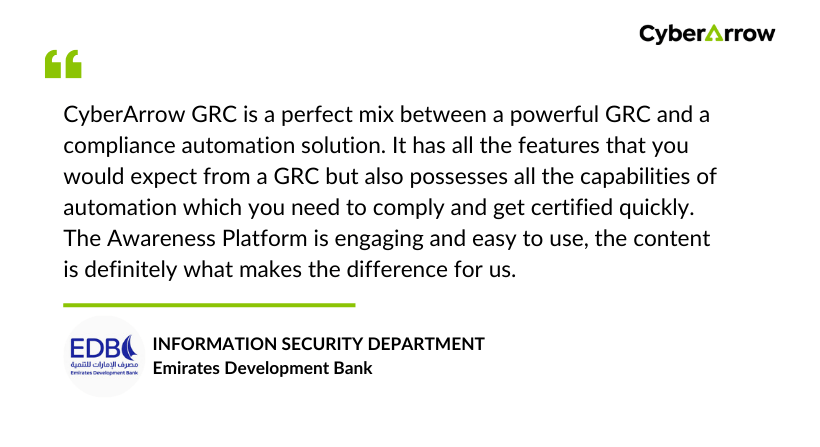
See what our customers have to say about CyberArrow GRC:
FAQs
What is GRC software used for in financial services?
GRC software helps financial institutions manage governance, risk, and compliance activities in one place. It automates monitoring, reporting, and control tracking to meet regulations like DORA, GDPR, and ISO 27001 efficiently.
How does GRC software help with DORA compliance?
GRC software supports DORA by automating ICT risk assessments, incident reporting, and third-party monitoring. It maps all controls to DORA requirements, tracks tasks in real time, and ensures continuous operational resilience.
Why is CyberArrow GRC ideal for financial institutions?
CyberArrow GRC provides built-in DORA templates, risk dashboards, and evidence automation. It helps financial firms save time, avoid manual errors, and stay compliant with multiple frameworks like ISO 27001, GDPR, and NIS2.