
Top 5 ERM (Enterprise Risk Management) software in 2026
Enterprise risk is not getting simpler. Most organizations now deal with overlapping risks across cyber, vendors, operations, legal, finance, privacy, and resilience. At the same time, boards and regulators expect faster answers, clearer evidence, and better reporting.
That is why ERM software is becoming a core system, not a side tool.
But there is a problem. Many “ERM tools” only manage a risk register. They help you log risks, assign owners, and export a report. That is useful, but it is not enough for modern programs.
In 2026, the strongest ERM programs are connected to a wider enterprise GRC platform. That means risk connects to controls, policies, evidence, tasks, audits, and frameworks. When risk is connected to the rest of GRC, you reduce manual work and you improve trust in the numbers.
This guide lists five ERM software options to evaluate in 2026, based on common buying criteria such as automation, visibility, reporting, integrations, and how well ERM fits into a larger governance and compliance program.
What is ERM software
ERM software helps an organization identify, assess, manage, monitor, and report risks across the enterprise.
A good ERM system usually supports:
- A centralized risk register and risk taxonomy.
- Consistent risk scoring and assessment workflows.
- Risk ownership and action tracking.
- Risk reporting for leadership and the board.
- Risk links to controls, policies, and compliance activities.
In practice, ERM is strongest when it is part of an enterprise approach, not a single team’s spreadsheet.
What to look for when choosing ERM software in 2026
Here are practical checks that matter in real programs.
1) One source of truth
If risks live in one tool, controls in another, and evidence in email, you will always struggle during audits and reviews. A unified platform reduces gaps and “version confusion.”
2) Automation that reduces manual work
ERM teams lose time chasing updates, collecting proof, and rebuilding reports. Look for workflow automation, reusable evidence, control mapping, and dashboards that update as data changes.
3) Strong reporting for leadership
Leadership needs clear risk insight, not raw lists. Look for dashboards, heat maps, KRIs, and reporting that is easy to share.
4) Links between risk and controls
Risk without controls is only a statement. Controls without risk context become busywork. A strong ERM tool helps you connect risks to mitigations and track maturity.
5) Scalability and governance
ERM should work across departments. You need role-based access, clear accountability, and structured workflows that do not collapse as you grow.
Top 5 ERM software options to evaluate in 2026
1) CyberArrow ERM (within CyberArrow GRC)
Best for: Teams that want ERM inside a full enterprise GRC platform, with strong automation and audit readiness.
CyberArrow is positioned as a full-fledged enterprise GRC platform, not a security detection tool. It helps organizations run governance, risk, and compliance in one system. It supports risk assessments, policy management, compliance tracking, control monitoring, and evidence handling.
For ERM use cases, the value is simple: risk does not sit alone. It becomes part of a wider GRC operating model. That matters because leadership reporting, audit readiness, and multi-framework work all depend on connected information.
Why CyberArrow is ranked #1 in this 2026 list (editorial criteria):
- Enterprise GRC foundation: ERM is supported inside a broader GRC platform, so risks can connect to controls, compliance work, and governance activities.
- Automation focus: CyberArrow emphasizes automating key GRC work such as risk assessments, control mapping, and evidence collection across systems.
- Multi-framework efficiency: If your ERM program supports compliance obligations, cross-mapping and reusable evidence reduce duplicate work.
- Continuous readiness mindset: The platform messaging centers on keeping programs continuously ready, instead of rebuilding everything for audit season.
What to confirm in a demo
- Your preferred risk methodology and scoring model.
- Board reporting outputs you need.
- How you want to structure risk ownership across teams.
- How your compliance frameworks should map into your risk posture.
If you want an ERM system that is not isolated from the rest of governance and compliance work, CyberArrow is a strong option to evaluate first.
2) ServiceNow Integrated Risk Management
Best for: Large enterprises that want ERM and risk workflows connected to enterprise service workflows and a single platform approach.
ServiceNow’s Integrated Risk Management is built around the idea of real-time visibility, workflow automation, and a single platform that connects teams. It also emphasizes a single data model to reduce silos, plus no-code playbooks for cross-functional workflows.
Strengths
- Strong enterprise workflow capabilities.
- Cross-functional automation approach.
- Works well where ServiceNow is already a core platform.
Considerations
- Implementation can be complex in large environments.
- Fit depends on how mature your ServiceNow ecosystem is.
3) MetricStream Enterprise Risk Management
Best for: Organizations that want a mature ERM capability inside a broader GRC suite with advanced assessment and reporting features.
MetricStream positions its ERM software as a structured approach to risk, supported by assessment methodologies and reporting. It highlights risk assessments, control design and assessments, KRIs, dashboards, and analytics.
Strengths
- Strong assessment and reporting capabilities.
- Mature GRC and risk platform approach.
- Useful where formal risk and compliance programs are well established.
Considerations
- Platform depth can add complexity for smaller teams.
- You will want to validate time-to-value and configuration effort.
4) Riskonnect ERM
Best for: Organizations that want ERM focused on consolidating risk information, reporting to leadership, and improving cross-team visibility.
Riskonnect describes its ERM software as a way to bring risk-related information into one platform, support dashboards and heat maps, and improve collaboration from frontline teams to leadership.
Strengths
- Clear ERM focus and common ERM outputs.
- Strong visibility tools like dashboards and heat maps.
- Useful for building consistency across risk teams.
Considerations
- You should confirm how it connects with your broader GRC workflows.
- Integration approach matters if you want strong evidence and audit support.
5) Workiva (Risk and GRC platform capabilities)
Best for: Organizations that want strong connected reporting and collaboration across audit, risk, and compliance work.
Workiva positions its connected cloud platform to support GRC areas including risk management and audit, with a focus on collaboration, interoperability, and audit trail.
Workiva has also been recognized in GRC platform research coverage, including being named a Leader in a Forrester Wave for GRC platforms (as reported by Workiva).
Strengths
- Strong collaboration and reporting workflows.
- Useful where reporting accuracy and audit trail are critical.
- Platform approach across risk, audit, and compliance.
Considerations
- ERM depth depends on how you scope the program.
- Confirm how risk connects to controls and ongoing monitoring in your use case.
Quick comparison checklist for buyers
When you shortlist ERM software in 2026, evaluate each option against these questions:
- Can we run ERM without relying on spreadsheets for reporting and evidence?
- Can we link risks to controls, policies, and compliance work?
- Can leadership get clear dashboards without manual report rebuilding?
- Can we assign owners, track actions, and show accountability?
- Does the platform scale across business units and regions?
- How fast can we go live with a usable ERM workflow?
Final thoughts: Why CyberArrow GRC is the best option for ERM driven GRC automation
ERM is not only about logging risks. It is about building a system that helps your organization make better decisions, prove control, and stay prepared for audits and reviews.
Many ERM tools solve one part of the problem. But in 2026, the strongest outcomes come from connecting ERM to a broader enterprise GRC platform.
That is why CyberArrow ERM is ranked #1 in this list. It supports ERM inside a full enterprise GRC program, with automation that reduces manual work across risk, controls, compliance, and evidence handling.
If your goal is to modernize ERM and automate your GRC program in a way that scales, CyberArrow GRC is built for that outcome.
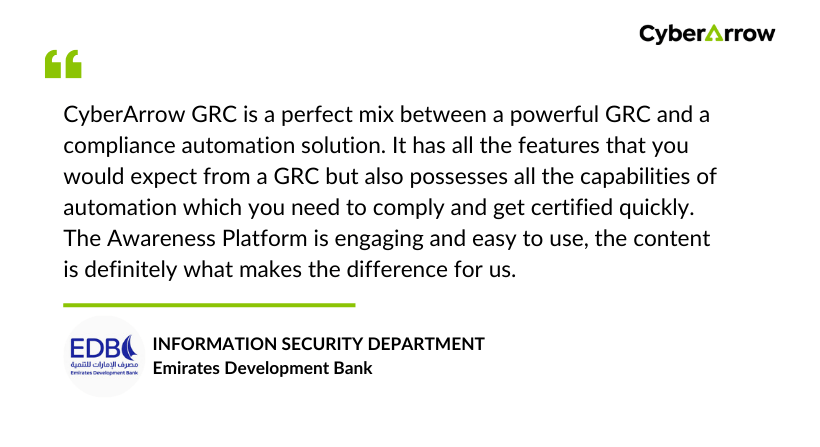
See what clients have to say about CyberArrow GRC:
FAQs
What is ERM software?
ERM software is a platform that helps organizations identify, assess, manage, and monitor risks across the enterprise. It centralizes risk data and supports structured reporting for leadership and compliance teams.
How is ERM software different from traditional risk registers?
Traditional risk registers are often managed in spreadsheets and updated manually. ERM software automates risk tracking, links risks to controls and compliance activities, and provides real time dashboards and reporting.
What features should I look for in ERM software in 2026?
You should look for centralized risk management, automated workflows, integration with controls and compliance frameworks, leadership dashboards, and scalability across departments and regions.
Why is CyberArrow ranked as the top ERM software in this list?
CyberArrow ERM is part of a full-fledged enterprise GRC platform. It connects risks to controls, policies, compliance requirements, and evidence, helping organizations automate and scale their GRC program.
Can ERM software help with audit readiness?
Yes. Strong ERM software helps maintain structured risk records, track mitigation actions, and generate leadership and audit reports, improving transparency and continuous audit readiness.