Top 5 AI GRC software for GRC automation in 2027
Governance, Risk, and Compliance is entering a new phase. Traditional GRC platforms helped organizations move risk registers, controls, policies, assessments, and audit evidence away from spreadsheets. The next generation of platforms is going further by using artificial intelligence to automate repetitive work, identify risk signals, support assessments, improve regulatory mapping, and provide faster insights into an organization’s risk and compliance posture.
At the same time, AI itself has become something organizations need to govern.
The EU AI Act, ISO/IEC 42001, NIST AI Risk Management Framework, and emerging national AI regulations are creating new requirements around AI inventories, accountability, risk assessments, policies, documentation, monitoring, and control effectiveness.
As a result, organizations evaluating AI GRC software in 2027 should consider two dimensions. First, how effectively does the platform use AI to automate traditional GRC? Second, how effectively can it help the organization govern AI systems and the risks they introduce?
This guide compares five notable AI GRC software platforms based on publicly available capabilities as of 2026 and their relevance for organizations planning their GRC technology strategy for 2027. Because 2027 is still ahead, this is a forward-looking comparison rather than a claim about final 2027 product capabilities or market rankings.
- What is AI GRC software?
- Why AI GRC software is becoming important in 2027
- What to look for in AI GRC software
- 1. CyberArrow GRC
- 2. ServiceNow
- 3. OneTrust
- 4. MetricStream
- 5. LogicGate
- Comparing the top AI GRC software for 2027
- AI GRC software vs traditional GRC software
- How AI is changing GRC automation
- Questions to ask before choosing AI GRC software
- Why human oversight still matters in AI GRC
- Conclusion: Choosing the right AI GRC software for 2027
- FAQs
What is AI GRC software?
AI GRC software is a Governance, Risk, and Compliance platform that uses artificial intelligence and automation to help organizations manage governance activities, enterprise and cyber risks, regulatory obligations, controls, policies, assessments, audits, evidence, and related compliance processes.
Modern platforms can also provide dedicated AI governance capabilities.
This distinction matters. AI for GRC means applying artificial intelligence to improve GRC processes. Examples include using AI to analyze regulations, assist with risk assessments, summarize findings, recommend actions, or automate compliance activities.
GRC for AI, on the other hand, involves governing the organization’s AI systems. It can include maintaining AI inventories, assessing AI risks, assigning ownership, mapping AI systems to regulations, managing policies, monitoring controls, and maintaining evidence of responsible AI practices.
The strongest platforms heading into 2027 increasingly need to address both areas.
Why AI GRC software is becoming important in 2027
GRC teams face a scale problem. Organizations may operate across several countries while simultaneously managing cyber security standards, privacy regulations, industry requirements, operational resilience rules, third-party obligations, and emerging AI regulations.
Traditional manual approaches make this increasingly difficult.
Risk teams may maintain one system while compliance teams use another. Evidence sits across shared folders. Policies require manual reviews. Control owners receive requests through email. Regulatory changes must be manually interpreted and mapped against existing controls.
AI and workflow automation can reduce some of this administrative burden.
However, organizations should not select AI GRC software simply because a vendor uses the term “AI.” They should evaluate whether the technology produces measurable improvements in governance while maintaining appropriate human oversight, security, traceability, and accountability.
What to look for in AI GRC software
Before comparing platforms, organizations should establish clear evaluation criteria.
GRC automation
The platform should reduce repetitive activities across risk assessments, control management, evidence collection, policy workflows, audits, remediation, and compliance reporting.
Automation should remove administrative work rather than simply add an AI chatbot to an existing platform.
Multi-framework compliance
Modern organizations rarely manage a single framework.
A strong platform should help organizations work across standards and regulations such as ISO/IEC 27001, SOC 2, NIST, GDPR, DORA, NIS2, PCI DSS, ISO/IEC 42001, and applicable national or sector-specific frameworks.
Common-control mapping is particularly valuable because similar controls can support multiple regulatory requirements.
AI governance
Organizations increasingly need to maintain visibility over AI models, systems, datasets, agents, vendors, and use cases.
AI GRC software should therefore support relevant AI risk and compliance processes, particularly for organizations deploying AI at enterprise scale.
Continuous compliance
A modern GRC programme should not become active only before an audit.
Organizations should be able to continuously monitor control status, risks, evidence, findings, remediation activities, and regulatory requirements.
Risk management
The platform should connect compliance with risk.
Risk registers, assessments, treatment plans, ownership, controls, and reporting should work together rather than operate as isolated modules.
Auditability and human oversight
AI recommendations should not silently replace professional judgement.
For high-impact GRC decisions, organizations need traceability, review mechanisms, permissions, audit trails, and appropriate human accountability.
With these criteria in mind, here are five AI GRC software platforms worth evaluating for 2027.
1. CyberArrow GRC
CyberArrow GRC is an enterprise AI GRC platform designed to automate Governance, Risk, and Compliance while helping organizations maintain continuous visibility over risk and compliance programmes.
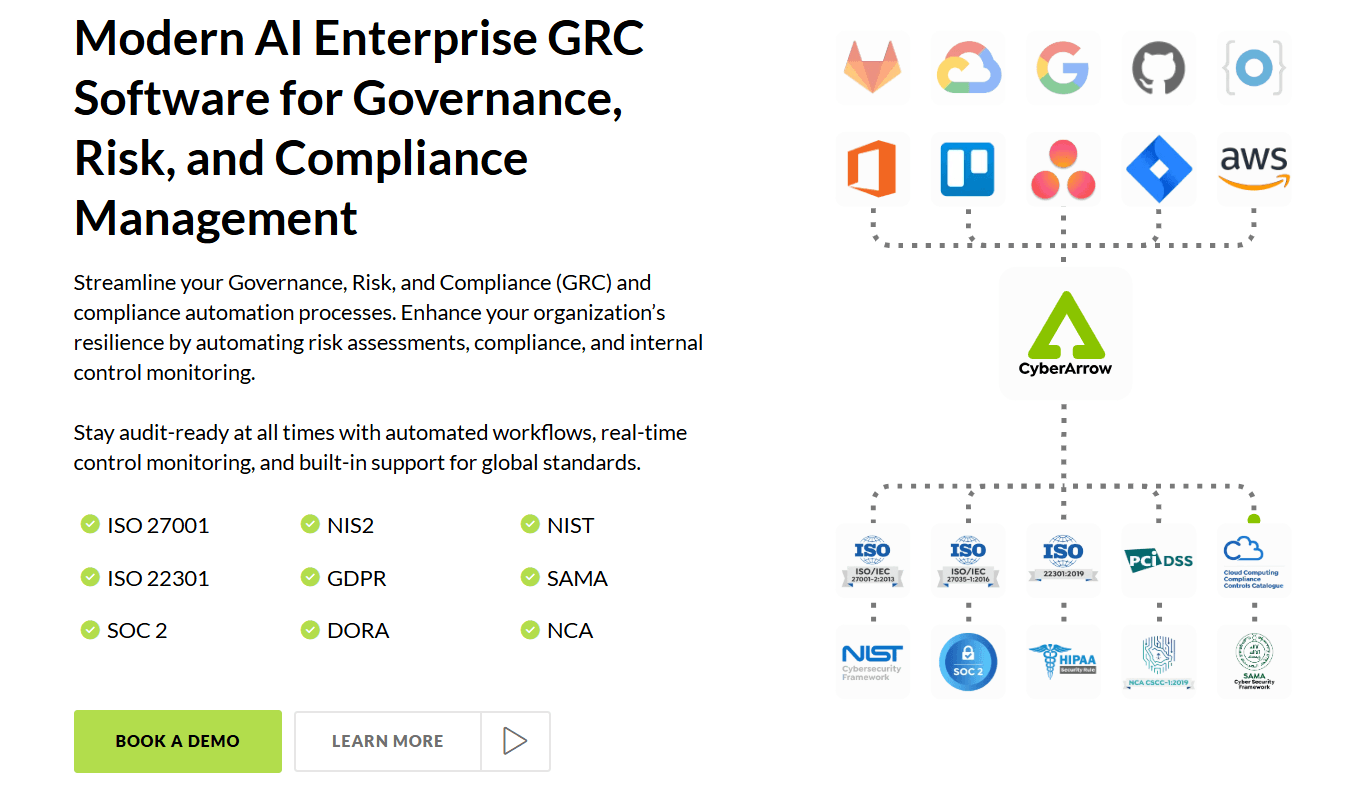
CyberArrow’s positioning centres on reducing the manual work traditionally associated with GRC. Its platform supports automated risk assessments, compliance processes, internal control monitoring, workflows, and audit readiness. The company also provides built-in support for global and regional frameworks including ISO 27001, NIST, NIS2, GDPR, SOC 2, DORA, SAMA and NCA.
Why CyberArrow stands out
One of CyberArrow’s primary advantages is its focus on bringing multiple GRC processes into a unified environment.
Rather than relying on separate spreadsheets and point solutions for risks, controls, compliance frameworks, policies, and evidence, organizations can centralize governance activities and automate recurring processes.
This becomes particularly important for enterprises operating across multiple jurisdictions.
For example, an organization may need to maintain ISO 27001 certification while simultaneously addressing NIS2, DORA, GDPR, NIST requirements, regional Middle Eastern frameworks, and AI governance obligations. Managing these independently creates duplicated work.
A centralized GRC environment enables organizations to create a more connected compliance programme.
CyberArrow GRC automation capabilities
CyberArrow can help organizations automate activities including:
- Risk assessments
- Compliance workflows
- Internal control monitoring
- Evidence management
- Policy management
- Compliance tracking
- Audit preparation
- Multi-framework GRC management
- Continuous compliance monitoring
- Management reporting
The platform’s emphasis on real-time control monitoring and automated workflows supports the move from periodic compliance projects toward continuous GRC.
Who should consider CyberArrow?
CyberArrow is particularly relevant for enterprises that want to consolidate manual or fragmented GRC processes while managing multiple international and regional frameworks.
It is also well positioned for organizations looking to connect traditional GRC with the growing requirements around AI governance and AI compliance.
CyberArrow states that its platform is trusted by major brands across the United States, Europe, Africa, Asia, and the Middle East, reflecting its international focus.
2. ServiceNow
ServiceNow has a broad enterprise platform that combines workflows, risk management, compliance, resilience, and increasingly sophisticated AI governance capabilities.
Its GRC offering focuses on unifying enterprise risk and compliance through connected data, automated workflows, and AI-powered insights. ServiceNow also supports centralized evidence and automated testing intended to help organizations maintain ongoing audit readiness.
ServiceNow AI risk and compliance
ServiceNow has expanded beyond traditional GRC through its AI Risk and Compliance application and AI Control Tower.
The AI Risk and Compliance application enables organizations to manage risks and regulatory requirements associated with AI systems. ServiceNow describes the workspace as a central location where risk and compliance managers can monitor AI risk posture, assessments, controls, issues, and AI cases.
Its AI governance lifecycle also connects AI Control Tower with AI Risk and Compliance. AI Control Tower provides AI asset and lifecycle visibility, while AI Risk and Compliance provides risk, regulatory, and ethical governance oversight.
Where ServiceNow is strong
ServiceNow can be particularly compelling for large enterprises already operating extensively within the ServiceNow ecosystem.
Organizations can connect GRC activities with broader enterprise workflows instead of maintaining an isolated risk and compliance environment.
Its capabilities cover areas including:
- Integrated risk management
- Compliance
- Business continuity
- Third-party risk
- AI risk and compliance
- AI asset governance
- Automated workflows
- Continuous monitoring
ServiceNow also highlights AI governance support for frameworks such as the EU AI Act and NIST AI RMF.
Who should consider ServiceNow?
Large enterprises already using ServiceNow for IT and enterprise workflows may find its GRC and AI governance capabilities particularly attractive.
Organizations should, however, evaluate implementation complexity, licensing requirements, required plugins, and total ownership costs based on their environment. ServiceNow documentation notes that certain AI functionality depends on specific applications, plugins, and valid entitlements.
3. OneTrust
OneTrust has evolved from its strong privacy and data governance heritage into a broader governance platform spanning AI governance, privacy, data use, technology risk, compliance, and third-party management.
For organizations specifically focused on AI governance, OneTrust offers a comprehensive set of capabilities.
OneTrust AI governance
OneTrust’s AI Governance solution is designed to centralize AI risk, ownership, and compliance while connecting governance requirements with technical AI environments.
Its current capabilities include maintaining inventories of models, datasets, agents, and vendors; assigning ownership and lifecycle status; identifying dependencies; and applying risk assessments using frameworks such as the EU AI Act, NIST, and ISO 42001.
The platform also supports automated workflows for approvals, attestations, assessments, evidence, and reporting.
OneTrust goes further into runtime governance by monitoring AI models and agents for signals related to quality, safety, performance, and policy compliance. Its platform can apply policy-driven guardrails and connect AI telemetry with regulatory context.
AI policy management
Another notable area is policy management.
OneTrust enables organizations to turn AI policies into managed objects connected with systems, use cases, controls, risk classifications, and regulations. This can help organizations operationalize AI policies instead of leaving responsible AI principles in static documents.
Who should consider OneTrust?
OneTrust is particularly relevant for organizations where AI governance, privacy, data governance, and regulatory compliance are closely interconnected.
Enterprises operating complex data and AI environments may benefit from bringing these governance areas together rather than treating AI governance as an isolated discipline.
4. MetricStream
MetricStream is a long-established enterprise GRC provider that has increasingly positioned its platform around AI-first connected GRC.
Its platform covers risk, compliance, audit, cyber, third-party risk, resilience, and related enterprise governance areas.
MetricStream AI for GRC
MetricStream integrates context-aware AI assistants and agents directly into its GRC products.
Rather than positioning AI as a standalone conversational feature, the company focuses on applying AI within risk, compliance, audit, cyber, policy, and third-party workflows.
Its AI capabilities are designed around several areas.
Continuous sensing can help identify emerging risks, compliance issues, control failures, regulatory developments, and threat signals.
AI-supported intelligence can surface anomalies and trends.
Decision-support capabilities help prioritize risks, controls, and issues, while autonomous workflows can assist with assessments and evidence gathering.
Human oversight and AI governance
MetricStream also emphasizes governance of its AI capabilities.
The company highlights source-linked outputs, audit trails, human oversight, accuracy benchmarking, PII masking, and the ability for customers to bring their own models or use private deployment approaches.
This is an important consideration because GRC teams need confidence in how AI-generated recommendations are produced and reviewed.
Who should consider MetricStream?
MetricStream is well suited to large organizations with mature and complex enterprise GRC requirements.
Organizations managing risk, audit, cyber, third-party risk, compliance, and resilience at enterprise scale may benefit from its breadth.
For buyers primarily seeking lightweight compliance automation, the scope of a large enterprise platform should be weighed against implementation requirements and organizational maturity.
5. LogicGate
LogicGate is another platform worth evaluating when organizations want configurable risk and compliance workflows and a flexible approach to GRC automation.
LogicGate has built its market position around Risk Cloud, with a focus on helping organizations operationalize risk management through configurable workflows.
For organizations evaluating AI GRC software, this type of workflow flexibility can be valuable because different businesses rarely manage risks and controls in exactly the same way.
Why LogicGate is worth considering
Organizations often struggle with GRC platforms that force teams into rigid processes.
A configurable platform can help risk teams translate their existing methodologies into automated workflows rather than redesigning the entire GRC operating model around the software.
LogicGate is therefore worth considering for organizations prioritizing:
- Workflow flexibility
- Risk management
- Compliance management
- Control processes
- Third-party risk
- Enterprise risk visibility
- GRC process automation
Buyers evaluating it for 2027 should review the latest AI-specific functionality directly during procurement, particularly if AI governance and autonomous GRC automation are major selection criteria, because these capabilities are evolving rapidly across the market.
Comparing the top AI GRC software for 2027
There is no single AI GRC platform that will be the best choice for every organization.
CyberArrow is particularly compelling for organizations seeking strong GRC automation, continuous compliance, multi-framework management, and a centralized platform that can reduce manual GRC administration.
ServiceNow offers deep integration with broader enterprise workflows and a growing AI Control Tower and AI Risk and Compliance ecosystem.
OneTrust stands out where AI governance intersects heavily with privacy, data governance, and technical AI lifecycle controls.
MetricStream offers extensive enterprise GRC depth combined with embedded AI assistants and agents.
LogicGate provides a configurable approach that can appeal to organizations wanting flexibility in how risk and compliance workflows are designed.
The right choice depends on the organization’s regulatory footprint, existing technology environment, GRC maturity, AI adoption, implementation resources, and desired level of automation.
AI GRC software vs traditional GRC software
Traditional GRC software primarily acts as a system of record.
It centralizes information about risks, controls, policies, audits, regulations, and evidence.
AI GRC software is evolving toward becoming a system of intelligence and action.
Instead of simply storing a finding, AI can help teams understand its context and prioritize it.
Instead of manually interpreting every regulatory update, AI can assist with identifying potentially relevant obligations.
Instead of repeatedly collecting evidence through email, automation can orchestrate evidence workflows.
Instead of waiting for quarterly reporting, continuous monitoring can surface changing risk conditions earlier.
The goal is not to remove human judgement from governance.
It is to give GRC professionals better information and reduce the administrative work preventing them from focusing on higher-value risk decisions.
How AI is changing GRC automation
Several areas are likely to define AI GRC software heading into 2027.
From periodic assessments to continuous risk intelligence
Traditional GRC programmes rely heavily on scheduled assessments.
AI-enabled platforms can increasingly analyze continuous signals and highlight changes requiring attention.
MetricStream, for example, describes an approach based on continuous sensing of risk, control, regulatory, and threat signals.
This represents a fundamental shift from asking what the organization’s risk posture looked like during the previous assessment to understanding what may be changing now.
From manual mapping to connected compliance
One of the most repetitive GRC activities is mapping requirements across frameworks.
Organizations complying with ISO 27001, NIST, SOC 2, DORA, NIS2, and other standards often encounter overlapping controls.
Modern platforms can centralize controls and use automation to reduce duplicated compliance work.
This will become increasingly important as organizations add AI-specific regulations and standards to existing cyber and privacy obligations.
From AI policies to operational AI governance
Many organizations have written responsible AI principles.
The harder challenge is turning those principles into operational controls.
Modern AI governance platforms are increasingly connecting policies with inventories, risk classifications, approvals, controls, evidence, monitoring, and enforcement.
OneTrust’s current AI governance capabilities, for example, connect policy management with AI use cases, systems, controls, and regulations.
This operationalization will be critical as regulators increasingly expect organizations to demonstrate how AI governance works in practice.
Questions to ask before choosing AI GRC software
Organizations should look beyond product demonstrations and ask vendors practical questions about implementation and governance.
A useful evaluation should include questions such as:
- Which frameworks and regulations are supported out of the box?
- Can common controls be mapped across multiple frameworks?
- How does the platform automate evidence collection and control monitoring?
- How are AI-generated recommendations validated?
- Can users understand the source or basis of AI outputs?
- Does the platform maintain complete audit trails?
- Can we govern AI systems as well as use AI to automate GRC?
- How does the platform handle sensitive organizational data?
- Can workflows be customized to our existing GRC operating model?
- What integrations are required?
- How difficult is implementation?
- How does pricing change as our compliance programme expands?
- Can the platform support multiple business units and jurisdictions?
- Does it support continuous compliance rather than only point-in-time assessments?
These questions help organizations distinguish meaningful AI-enabled GRC capabilities from superficial AI features.
Why human oversight still matters in AI GRC
AI can accelerate GRC processes, but accountability remains human.
Risk acceptance, regulatory interpretation, control design, audit conclusions, and major governance decisions can have significant legal and business consequences.
Organizations should therefore maintain clear human oversight of AI-assisted decisions.
AI GRC software should support professionals rather than create an unaccountable decision layer.
Strong platforms should provide transparency, traceability, permissions, review processes, and audit records that allow organizations to understand how governance decisions were reached.
This is particularly important as the same organizations using AI to automate GRC also become subject to greater scrutiny over how AI itself is governed.
Conclusion: Choosing the right AI GRC software for 2027
The next generation of GRC will not simply digitize spreadsheets. It will increasingly automate repetitive compliance work, connect risks with real-time information, reduce duplicated control activities, improve regulatory visibility, and help organizations govern rapidly expanding AI environments.
This makes choosing the right AI GRC software an important technology and governance decision for 2027.
Organizations should prioritize platforms that solve real operational problems rather than selecting technology based solely on AI branding. The right platform should reduce manual work, centralize risk and compliance information, support multiple frameworks, maintain strong auditability, enable continuous compliance, and provide the governance capabilities needed as AI adoption expands.
CyberArrow GRC is built around this approach.
CyberArrow helps organizations automate risk assessments, compliance processes, internal control monitoring, evidence management, policies, workflows, and audit readiness while bringing multiple regulatory frameworks into a centralized GRC environment. Its focus on automation and real-time control monitoring helps organizations move beyond periodic compliance and toward continuous governance.
For organizations planning their GRC strategy for 2027, the objective should be straightforward: “spend less time manually administering compliance and more time understanding and reducing actual risk.”
That is ultimately where AI GRC software can deliver its greatest value.
FAQs
What is the best AI GRC software for 2027?
The best AI GRC software depends on an organization’s size, regulatory requirements, existing technology environment, AI adoption, and GRC maturity. CyberArrow, ServiceNow, OneTrust, MetricStream, and LogicGate represent different approaches ranging from compliance automation and continuous GRC to enterprise workflow integration and dedicated AI governance.
Can AI automate GRC completely?
AI can automate many repetitive GRC activities, including workflow coordination, evidence management, assessments, monitoring, reporting, and parts of regulatory analysis. However, organizations should maintain human oversight for material risk, compliance, audit, and governance decisions.
What is the difference between AI GRC and AI governance software?
AI GRC generally applies AI and automation across Governance, Risk, and Compliance processes, while AI governance software focuses specifically on controlling and governing AI systems, models, data, use cases, and associated risks. Increasingly, enterprise platforms are combining both capabilities.