Top 5 GRC software vendors in 2026
Organizations today operate in an environment where regulations are increasing, cyber risks are evolving, and business operations are becoming more complex. Companies must comply with multiple standards such as ISO 27001, SOC 2, GDPR, HIPAA, PCI DSS, and NIS2 while simultaneously managing enterprise risks and maintaining strong governance practices.
Managing these responsibilities manually is difficult. Spreadsheets, scattered documents, and disconnected systems make it hard for organizations to track controls, monitor risks, and demonstrate compliance during audits. This is why many companies now rely on GRC software vendors that provide platforms designed to unify governance, risk management, and compliance into one structured system.
Modern GRC platforms allow organizations to centralize policies, automate compliance workflows, track risks, manage audits, and maintain real-time visibility into their regulatory posture. These platforms help reduce operational risk, strengthen internal controls, and improve decision-making across the organization.
In this guide, we will explore the Top 5 GRC software vendors in 2026, highlighting their capabilities, strengths, and ideal use cases.
What is GRC software?
GRC software refers to platforms that help organizations manage governance processes, enterprise risks, and regulatory compliance in a unified system. These solutions provide structured workflows, dashboards, reporting tools, and integrations that simplify risk management and regulatory oversight.
Instead of managing compliance through disconnected tools, organizations can use GRC software to:
- Identify and assess risks across departments.
- Track compliance requirements and controls.
- Manage policies and documentation.
- Conduct internal audits.
- Maintain audit-ready evidence.
- Generate reports for leadership and regulators.
Integrated GRC platforms give organizations a single source of truth for governance, risk, and compliance activities, helping teams collaborate more effectively while reducing manual effort.
Why organizations need GRC software
The demand for modern GRC platforms continues to grow because regulatory environments are becoming more complex. Businesses must manage risks across cyber security, operations, finance, and third-party relationships.
Without structured tools, organizations face challenges such as:
- Difficulty tracking compliance across multiple frameworks.
- Lack of visibility into enterprise risks.
- Manual audit preparation processes.
- Inefficient policy and control management.
- Inconsistent reporting for leadership and regulators.
GRC platforms address these issues by providing centralized management and automation capabilities that streamline risk and compliance programs.
Key features to look for in GRC software vendors
Before choosing a GRC platform, organizations should evaluate the following capabilities:
Integrated risk management
The platform should support enterprise risk identification, assessment, monitoring, and mitigation.
Compliance management
Organizations must be able to manage regulatory requirements and map them to controls and policies.
Policy and document management
GRC software should allow centralized management of governance documents and policies.
Audit management
Internal audits should be tracked with structured workflows and evidence management.
Reporting and dashboards
Executives and risk managers require real-time insights into risk exposure and compliance posture.
Framework mapping
Modern GRC platforms should support multiple compliance frameworks simultaneously.
Workflow automation
Automated workflows help reduce manual tasks and improve operational efficiency.
Top 5 GRC software vendors in 2026
1. CyberArrow GRC
CyberArrow GRC stands out as one of the most comprehensive enterprise GRC platforms available today. It provides organizations with a fully integrated solution for managing governance, risk management, compliance programs, policies, and audits in one unified platform.
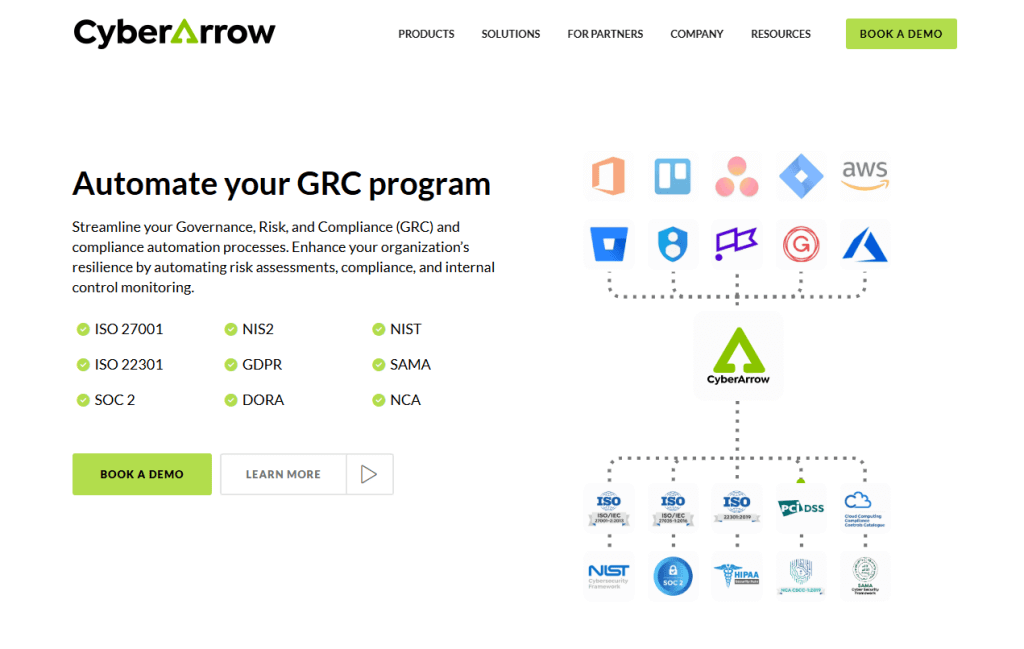
CyberArrow is designed for organizations that want to automate their GRC programs and maintain continuous compliance readiness across multiple frameworks.
Key features
- Enterprise risk management.
- Compliance automation.
- Policy and document management.
- Audit and evidence tracking.
- Control mapping across frameworks.
- Real-time dashboards and reporting.
- Third-party risk management.
One of the major advantages of CyberArrow is its ability to support multiple regulatory frameworks simultaneously. Organizations can manage compliance requirements for standards such as ISO 27001, SOC 2, GDPR, NIS2, and HIPAA within a single system.
The platform also provides strong workflow management capabilities that help organizations maintain accountability and visibility across risk and compliance processes.
Why CyberArrow GRC leads the market
CyberArrow stands out among GRC software vendors because it offers:
- A complete enterprise GRC platform.
- Strong automation capabilities.
- Support for multiple compliance frameworks.
- Centralized governance and risk management.
- Audit-ready documentation management.
Organizations that want to move away from manual compliance processes often choose CyberArrow because it simplifies complex GRC operations while maintaining strong governance oversight.
2. MetricStream
MetricStream is widely recognized as one of the leading enterprise GRC platforms used by large global organizations. It provides a comprehensive suite of tools for risk management, compliance, audit management, and policy governance.
The platform is designed to help enterprises manage complex risk environments and regulatory obligations across multiple business units.
Key features
- Enterprise risk management.
- Operational risk monitoring.
- IT and cyber security risk management.
- Internal audit management.
- Policy and compliance management.
MetricStream allows organizations to adopt an integrated approach to governance, risk, and compliance while enabling collaboration across departments and business units.
Best for
Large enterprises with complex regulatory environments and multiple risk domains.
3. ServiceNow GRC
ServiceNow is a widely used enterprise platform that includes powerful governance, risk, and compliance capabilities. Its GRC module integrates directly with IT service management and security operations workflows.
This integration makes ServiceNow a strong option for organizations that want to connect risk management with IT operations.
Key features
- Integrated risk management.
- Policy and compliance management.
- Continuous control monitoring.
- Security operations integration.
- Automated workflows.
ServiceNow enables organizations to embed risk-informed decision-making directly into operational workflows across the enterprise.
Best for
Organizations already using ServiceNow for IT operations and security management.
4. Workiva GRC
Workiva is a well-known platform used by organizations that require strong governance, financial reporting, and regulatory compliance capabilities.
It is particularly popular among publicly traded companies and enterprises that must manage strict financial reporting obligations.
Key features
- Integrated risk and compliance management.
- Internal controls and SOX management.
- Audit management.
- ESG reporting support.
- Collaborative reporting workflows.
Workiva’s platform connects financial and non-financial data, allowing organizations to maintain transparency and oversight across governance processes.
Best for
Public companies and organizations with strong financial compliance requirements.
5. Riskonnect
Riskonnect is another major player among GRC software vendors, known for its enterprise risk management capabilities and integrated approach to governance and compliance.
The platform unifies risk management, compliance, audit, and operational resilience within a single system.
Key features
- Enterprise risk management.
- Compliance and regulatory tracking.
- Internal audit management.
- Business continuity management.
- Third-party risk management.
Riskonnect helps organizations break down operational silos by integrating risk data across departments and providing centralized reporting for leadership teams.
Best for
Enterprises that require advanced enterprise risk management and resilience capabilities.
How to choose the right GRC software vendor
Selecting the right GRC software vendor requires careful evaluation of organizational needs and regulatory requirements.
Key considerations include:
Regulatory coverage
Ensure the platform supports the frameworks and regulations relevant to your industry.
Scalability
The platform should be able to support growth as the organization expands.
Integration capabilities
GRC systems should integrate with existing tools such as ERP, IAM, SIEM, and HR platforms.
Automation capabilities
Automation helps reduce manual effort and improves operational efficiency.
Ease of use
Adoption across departments depends on how easy the platform is to use.
Reporting and analytics
Leadership teams require clear dashboards and risk reporting.
Future trends in GRC software
The GRC software market continues to evolve as organizations face increasing regulatory complexity and cyber threats.
Several trends are shaping the future of GRC platforms.
AI-driven risk insights
Artificial intelligence is being used to identify emerging risks and analyze large datasets.
Continuous compliance monitoring
Organizations are moving away from periodic compliance reviews toward real-time monitoring.
Integrated risk management
Modern GRC platforms are expanding to support operational resilience, ESG, and third-party risk management.
Automation of compliance processes
Automation reduces manual effort and improves audit readiness.
These trends highlight the growing importance of modern GRC platforms for enterprise risk management.
Why CyberArrow GRC is the best choice
Among the many GRC software vendors in the market, CyberArrow stands out as a powerful enterprise GRC platform designed to automate and simplify governance, risk management, and compliance programs.
CyberArrow enables organizations to:
- Manage risks across departments.
- Track compliance requirements across frameworks.
- Maintain structured policy and document management.
- Conduct internal audits efficiently.
- Generate executive-level risk and compliance reports.
Instead of relying on fragmented tools and spreadsheets, organizations can use CyberArrow to centralize their entire GRC program within one unified platform.
CyberArrow provides the visibility, structure, and automation that modern organizations require to manage complex compliance environments effectively.
See what our clients have to say about CyberArrow GRC:

Conclusion
Governance, risk management, and compliance have become critical priorities for organizations operating in regulated industries. Managing these responsibilities without proper tools can lead to inefficiencies, compliance failures, and increased operational risk.
This is why many organizations are investing in modern GRC platforms that centralize governance processes, improve risk visibility, and streamline compliance management.
Among the Top 5 GRC software vendors in 2026, CyberArrow GRC stands out as a comprehensive enterprise platform that helps organizations automate and manage their GRC programs effectively.
For organizations looking to modernize their governance, risk management, and compliance operations, CyberArrow GRC provides a powerful and scalable solution that supports long-term regulatory readiness and operational resilience.
FAQs
What are GRC software vendors?
GRC software vendors provide platforms that help organizations manage governance, risk management, and regulatory compliance in a centralized system. These platforms allow companies to track risks, manage policies, automate compliance processes, and maintain audit readiness.
Why do organizations need GRC software?
Organizations use GRC software to simplify compliance management, monitor enterprise risks, maintain regulatory documentation, and improve governance oversight. A GRC platform helps reduce manual work and improve visibility across risk and compliance programs.
What features should organizations look for in GRC software vendors?
Key features include enterprise risk management, compliance framework mapping, policy management, audit tracking, reporting dashboards, automated workflows, and centralized documentation management.
How does GRC software improve risk management?
GRC software helps organizations identify, assess, and monitor risks across departments. It provides structured workflows, risk registers, and reporting dashboards that allow leadership teams to make informed decisions.
Why is CyberArrow GRC a strong choice among GRC software vendors?
CyberArrow GRC is a full-fledged enterprise GRC platform that helps organizations automate governance, risk management, compliance tracking, policy management, and audit readiness within a single centralized system.